


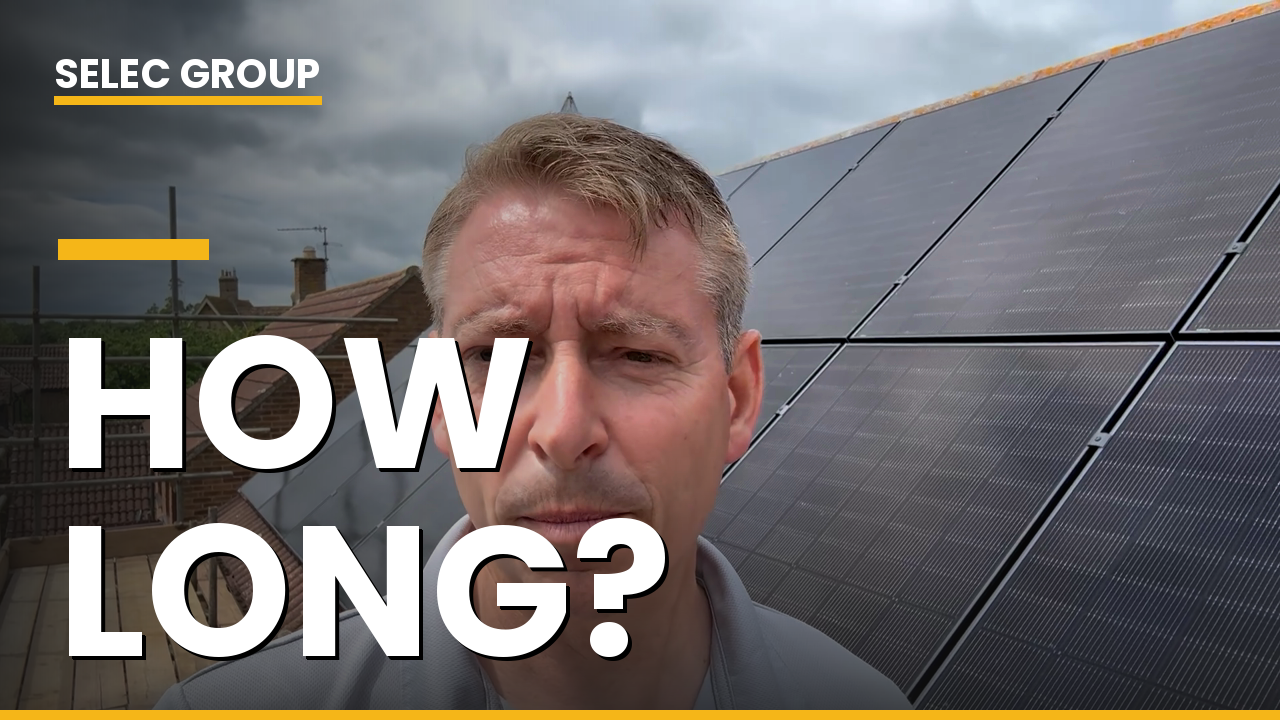
I am Jason Pope from Selec Group, solar panel installers based in Cambridgeshire. One of the first things people ask me is how long it takes to put up a solar system. The honest answer is it depends, because it genuinely does. A big, complex roof takes longer than a simple one. But I can give you a clear shape for how we run a job, why we spread it the way we do, and why a company that promises to fit your whole system in a single day should make you cautious rather than impressed.

Our three week programme
We plan a job over a three week window. That does not mean three weeks of work. It means three sensible steps with breathing room around the part that matters.
- Week one: scaffold and equipment. The scaffolding goes up, usually a day, sometimes a day and a half. We also finalise the equipment so everything is ready.
- Week two: the install. The kit arrives and we fit the system. This normally takes about a week, depending on weather, wind and how many panels there are.
- Week three: scaffold down. After we have handed the system over, the scaffolding comes down.
So although the job spans three weeks on the calendar, the actual installation is about a week. The space around it is deliberate, and the reason for that is the whole point of this post.
Why one day is a red flag
Some companies turn up and do the lot in a single day, and a lot of people think that is a good thing. I do not, and here is why.
To install a full system in a day, a firm needs a lot of people on the roof, and they need to be somewhere else doing exactly the same thing tomorrow. That pace creates a problem. If they get up there and need something from the van that they have not got, the schedule does not allow them to stop and sort it. So they bodge it and move on.
We work the opposite way. By spreading the install over a week, with the following week still available, we give ourselves room to do it right.
- If the roof tiles are not quite what we expected and a better roof hook would suit, we go and get the better hook.
- If something does not feel right, we take it out and put another one in.
- We are never racing a clock that forces a corner to be cut.
That flexibility is what separates a proper install from a fast one.
You can actually inspect our work
Here is the part that does not get talked about enough. With a one day install, the scaffold often goes up first thing, the roof is done, and the scaffold comes down by the end of the day with everything fitted and running. Great for disruption, terrible for accountability.
Because by the time you get home, you have had no chance to check anything. You cannot see under the panels. You cannot see whether the roof hooks were fitted correctly. You cannot see whether the tiles were notched to sit snug over the hooks. You cannot see whether anything underneath got damaged.
With our systems, everything is open while we work. I am not telling you to climb our scaffolding, please do not, but while we are off site, you are welcome to come and have a look at what has been done. We take photos throughout anyway, so you have a record either way. Nothing is hidden.
What good roof work actually involves
Since you can see our work, it is worth knowing what to look for, because the bits under the panels are where quality lives or dies.
- Roof hooks screwed into the rafters. All of our roof hooks are fixed into the rafters with proper stainless steel screws. The rafters are the structural timbers, and that is what the array must be anchored to, not just the tiles or the battens.
- Notched tiles. We notch the tiles where needed so they sit snug over the roof hooks rather than being forced or left proud, which is how leaks start.
- Flashings where needed. We use flashings under the tiles where required to keep everything waterproof. A slate tile, for example, needs extra flashing to stay watertight around a hook.
None of that is visible from the ground once the job is done, which is exactly why the chance to inspect it before the scaffold comes down matters. We want the install to be the best it can be, and we are happy for you to check that it is.
Employed teams and proper scaffolding
The way a job is staffed and accessed tells you a lot. My recommendation is always to go with a small local company that works on its reputation in its own area.
Some firms are out of area. They come from a cheaper part of the country, turn up with five or more people, bash the system out and disappear. Others are large companies using subcontractors, so you have no idea who is actually carrying out the work. With a small local company you meet the people, a small team who are mostly employed.
The only contractor on our sites is the scaffolder, because we believe a professional scaffolding firm should put up the scaffold, not us. Some companies fit off ladders instead, which is cheaper for the customer or more profit for them, but it is dangerous. Fall off a roof and you are not coming back from that. Proper scaffolding is not an optional extra.
The bottom line
A solar install runs over about three weeks on the calendar, but the real work is roughly a week, and that pace is deliberate. It gives us room to fix roof hooks into rafters with stainless steel screws, notch tiles, fit flashings and put anything right that does not feel correct, all while you can still see it. A one day install hides all of that from you. We do it properly, with a small mostly employed team and a professional scaffolder, across Cambridgeshire, Bedfordshire and Northamptonshire. If you want solar fitted right and want to be able to check the work, call the office on 01480 400 607 or request a survey through our website.
Jason Pope
Owner, Selec Group