


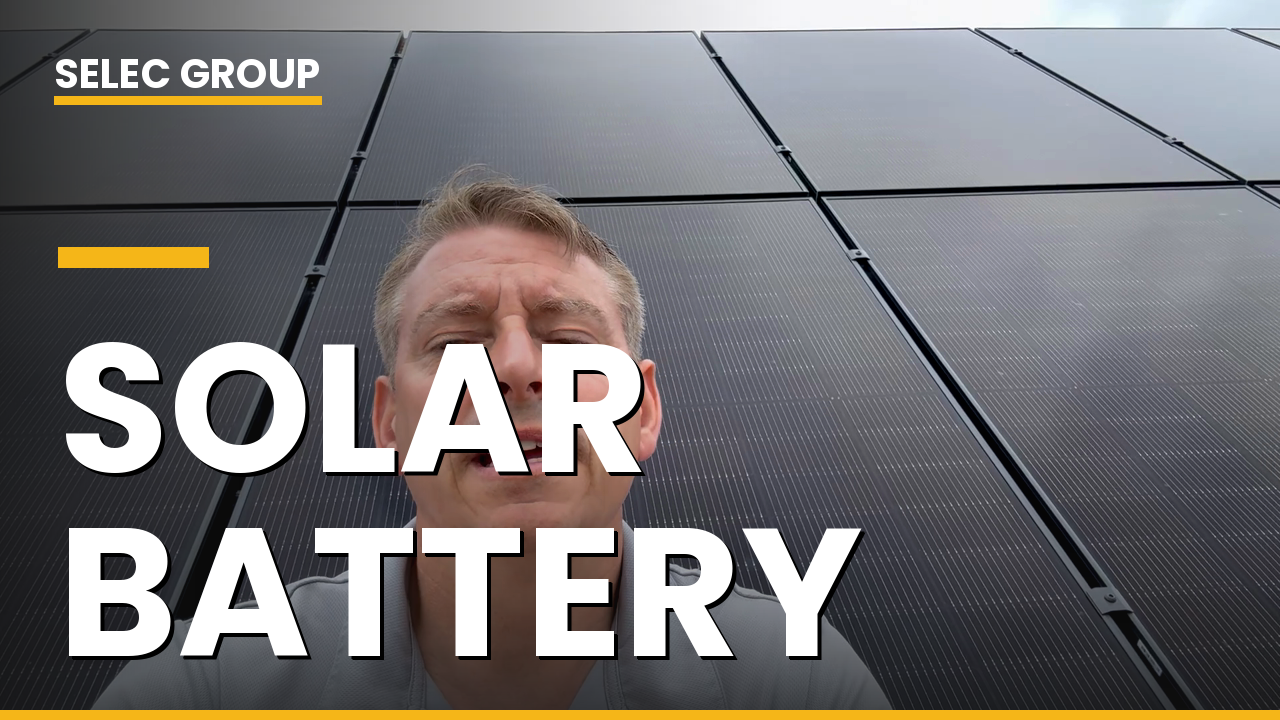
Behind me is a solar system with a 9 kilowatt hour battery. It could be any size, on any house, but the principle is the same. A battery stores the electricity your panels make when you have spare, and gives it back when you need it. That sounds simple, and it is, but understanding the flow helps you see why a battery is worth having. In this post I will walk you through how the electricity moves from your roof, through the inverter, into your house, the battery and the grid, and why a battery often pays for itself in five to six years.

From sunlight to usable power
Your panels turn sunlight into electricity. That electricity is DC, direct current, which is the same type a torch battery puts out. Your house cannot use DC. Everything in your home runs on AC, alternating current, the type that comes from the grid.
So the power off your roof goes down to the inverter. The inverter is the box that does the conversion. It takes DC from the panels and turns it into AC for the house. The inverter is the brain of the system. It decides, second by second, where the power should go.
Where the electricity goes next
Once the inverter has made AC, there is an order of priority:
- First, it powers your house. If you are using electricity right now, the panels cover it.
- Second, if there is spare, it charges the battery.
- Third, once the battery is full and the house is satisfied, the spare goes back to the grid.
That last bit earns you money through the Smart Export Guarantee, which pays you for every unit you export.
What happens when you put the kettle and oven on
Here is where a battery earns its keep. Say you switch the oven on and boil the kettle at the same time. That is a big, sudden draw. A typical array will not produce enough to cover both at once.
Without a battery, the shortfall comes from the grid at full price. With a battery, the extra power comes out of the battery instead. The house gets what it needs and you take nothing from the grid. The battery quietly fills the gap.
Riding through the clouds
The other common situation is cloud. Picture a bright day. Your panels are producing well, then a big cloud drifts in front of the sun just as you flick the kettle on. Production drops for a moment.
The battery covers that dip. Power comes out of the battery to keep the house going. Then the cloud passes, the panels pick up again, and the spare flows back into the battery to top it up. You never notice it happening. The system smooths out the bumps so your supply stays steady.
Are our batteries worth it?
Yes. In plain terms, a battery means you use far more of your own solar instead of selling it cheap and buying it back dear. Most of our batteries pay for themselves in five to six years, depending on how you use them. Use more of your stored power instead of grid power and the payback comes quicker.
Batteries are also modular. You can start with one and add more later as your needs grow, for example when you move from gas to electric heating.
Moving cheap power into expensive hours
This is the part many people miss. A battery does not only store solar. It can also store cheap grid electricity and use it when grid electricity is expensive.
My own electricity at home is about 7 pence a unit overnight and about 30 pence a unit during the day. So I charge my batteries overnight at 7 pence. Then, during the day, if I need power and the sun is not giving me enough, I take it from the battery at 7 pence instead of buying it from the grid at 30 pence.
That is a saving of roughly 23 pence on every unit I shift. The trade is called time of use, and it works like this:
- Set the battery to charge in the cheap overnight window.
- Run the house off the battery during the expensive daytime hours.
- Let the solar top the battery back up whenever the sun is out.
It matters most in winter, when the days are short and dark and the panels make less. But it still works in summer as a backstop. Whatever the season, you are buying electricity at the cheapest possible rate and avoiding the dear rate.
How big a battery do you need?
There is no single right answer, and it comes down to how much electricity you use in the evenings and overnight, and what you want the battery to do. A smaller battery covers the evening peak and rides out short dips. A larger stack, or several modules working together, can carry an electrically heated home through a dark winter day on cheap overnight power alone. Because the systems are modular, you do not have to decide everything on day one. Start with what suits you now and add capacity later as your needs change, for example when you fit an electric car charger or move your heating across to air conditioning.
The bottom line
A solar battery does three jobs. It stores your spare solar instead of selling it cheap. It covers sudden surges and cloud so your supply stays smooth. And it lets you buy power at night when it is cheap and use it by day when it is dear. Put together, that is why most of our batteries pay for themselves in five to six years.
We design and fit solar and battery systems across Cambridgeshire, Bedfordshire and Northamptonshire, in places like Spaldwick, Huntingdon, St Neots and Buckden. If you want to know what size battery suits your home and how you use power, call the office on 01480 400 607 or request a survey through our website.
Jason Pope
Owner, Selec Group