


This is one of the most common questions I get, and like a lot of my answers, it depends. The good news is there is a simple rule of thumb that gets you a sensible figure in seconds, and you can sanity check it against your own electricity bill. In this post I will give you that rule, show you how to work out how many panels you might need, and explain the things that change the answer. I will keep the maths simple and honest.
A simple rule for a single panel
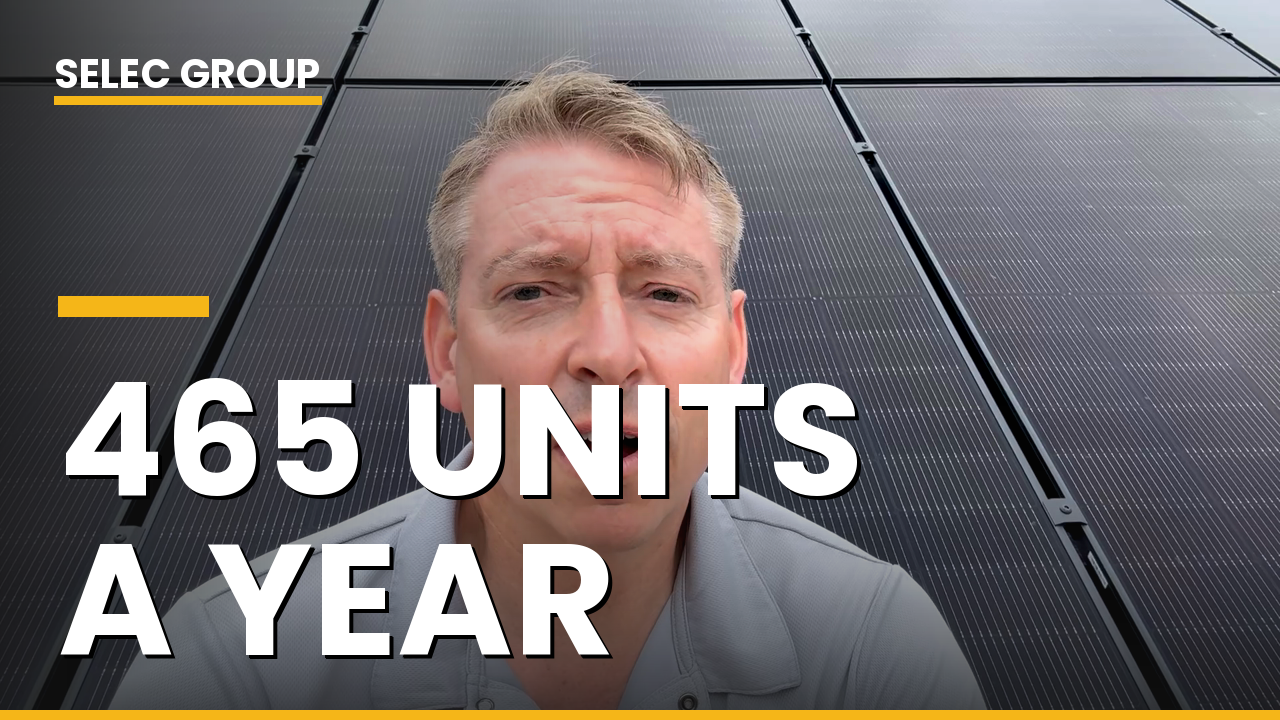
Take the panels on this job. They are south facing and rated at 465 watts each. Roughly speaking, each one will produce about 465 kilowatt hours of electricity in a year here in the UK. A kilowatt hour is the same as a unit on your bill.
So the rule is this: a south facing panel in the UK produces, over a year, roughly the same number of kilowatt hours as its wattage. A 465 watt panel makes around 465 units. A 400 watt panel makes around 400 units. It is a rough rule, not a guarantee, but it is close enough to picture what a system will do.
How to read your own usage off your bill
To make this useful, you need to know how much electricity you actually use. Your bill tells you.
Every electricity bill carries an estimate of your annual usage in units, which is the same as kilowatt hours. Find that figure and you have your starting point.
For example, say your bill shows 2,500 units a year. That is fairly low usage for a home, but it makes the sum easy to follow.
Working out how many panels you need
Now put the two figures together.
If each panel makes about 465 units a year, and you use 2,500 units a year, then in theory:
- 2,500 divided by 465 is just over five panels to match your usage on paper
- But solar does not line up neatly with when you use power, so in practice you fit more
- Around ten panels of this size would comfortably cover that level of usage across the year
In simple terms, with enough panels you can produce as much electricity over a year as you use, which in theory means a zero electricity bill. One 465 watt panel will not do it on its own, but a roof full of them can produce enough that your annual generation matches or beats your annual usage.
Why a battery changes how it works
There is a catch, and I will be straight about it. Producing enough over a year is not the same as using it at the right moment.
Panels make most of their power in the middle of the day. If nobody is home then, that electricity gets exported rather than used. You still get paid for export through the Smart Export Guarantee, but you save far more by using your own power than by selling it.
That is why most people fit a battery alongside the panels. The battery stores your midday surplus so you can use it in the evening, and it lets you run the house differently. So in reality you would not just match generation to usage on paper, you would store and shift power to get the most out of every unit the panels make.
The things that change the answer
The 465 rule is a guide. Several factors move the real figure up or down:
- Wattage. A higher rated panel makes more. The output roughly tracks the wattage.
- Orientation. These panels face south, which is ideal. East or west facing roofs produce less, though they can still be well worth it.
- Roof angle. The pitch of the roof matters. There is an angle that catches the sun best, and roofs vary.
- Location. Where you are in the world changes how much sun you get. Here in Cambridgeshire the rule holds up well.
For Cambridgeshire, the calculator we use indicates that a south facing roof will, on average, give you in kilowatt hours roughly the number of watts the panel produces. That is exactly where the 465 rule comes from.
How we give an exact figure
The rule of thumb is fine for a quick picture. For a real quote, we do better than that.
We use proper performance estimate software, the same kind required under MCS, which is the quality scheme for renewables. It takes your specific panel wattage, the direction your roof faces, the angle of the pitch and your location, then gives a far more precise estimate of annual generation for your house.
So you do not have to rely on a general rule when you commit. You get a figure modelled on your actual roof.
A real example on this job
On this installation we have sixteen of these 465 watt panels. Using the simple rule, that is around 7,400 kilowatt hours a year. That is a considerable amount of electricity, enough to cover most homes and leave a surplus for a battery or for export.
The bottom line
A south facing panel in the UK produces, over a year, roughly the same number of kilowatt hours as its wattage, so a 465 watt panel makes around 465 units. Read your annual usage off your bill, divide by that figure, and you get a rough idea of how many panels you need. Then we model it exactly for your roof, and we usually add a battery so you actually use what you make.
We design and fit solar across Cambridgeshire, Bedfordshire and Northamptonshire, and we will give you a precise generation estimate for your home. Call the office on 01480 400607 or request a survey through our website.
Jason Pope
Owner, Selec Group