


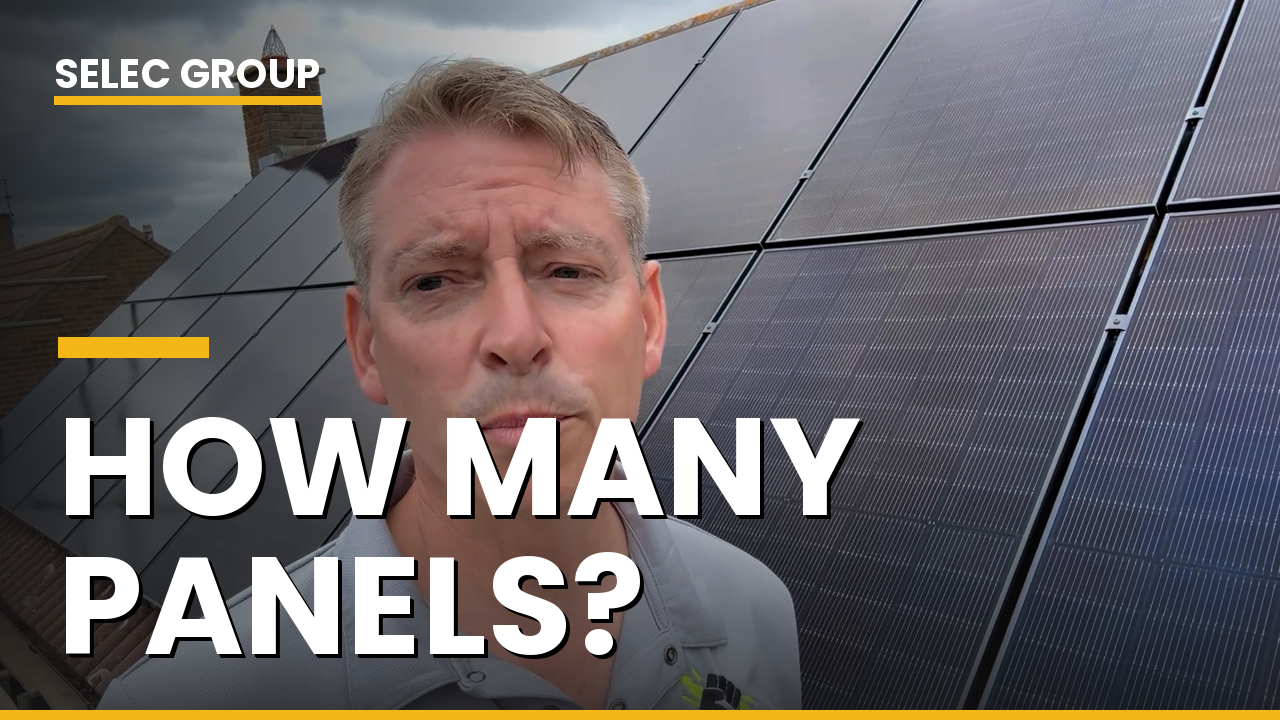
I get asked this on nearly every survey, and my answer is straightforward. Fit as many as you can. There is good reason for it, and it comes down to how the costs of a solar job are structured. Behind me on this installation is a lot of scaffolding, and that scaffolding costs the same whether we hang one panel on the roof or sixteen. In this post I will explain why filling the roof is usually the smart move, why I would fit panels before a battery if money is tight, and why going back up later is an expensive mistake.

The simple rule: fill the roof
When people ask how many panels to fit, my honest reply is as many as the roof will take. If we are going to put scaffolding up and get on your roof, we may as well make the most of the trip.
A bigger array means more electricity over the life of the system. More of your bill covered. More to store in a battery or export for a payment. The panels are the engine of the whole thing, so the more you fit, the more the system earns for decades to come.
Why scaffolding changes the maths
To understand my answer you need to understand fixed and variable costs.
- A fixed cost is one you pay no matter the size of the job. Scaffolding is the obvious one. Putting it up, hiring it and taking it down costs roughly the same whether you fit four panels or sixteen.
- A variable cost is one that rises with the size of the system. Each extra panel costs a bit more in kit and a bit more in labour.
Here is the key point. Once you have committed to the scaffolding, that money is spent either way. Spreading it across sixteen panels rather than four means each panel carries a much smaller share of that fixed cost. So the extra panels are some of the best value kit on the whole job, because they ride on scaffolding you have already paid for.
That is why filling the roof so often makes sense. You are getting more generation for a smaller marginal cost.
Panels before battery if the budget is tight
Sometimes the budget will not stretch to everything at once. If that is you, my advice is usually to fill the roof with panels first and add the battery later.
There are two reasons:
- You can add a battery at almost any time. Battery systems are modular, so you fit one when funds allow, and the work does not need scaffolding.
- You cannot easily add panels later. Adding panels means getting back on the roof, which means scaffolding again, and that is the expensive bit.
So if a choice has to be made, I would cut elsewhere and still fill the roof. Get the generation in place while the scaffold is up, then build the storage around it over time.
The cost of going up twice
Some people fit a small array, then decide a year or two later they want more. The trouble is the second trip up the roof is not cheap.
You pay for scaffolding all over again. That fixed cost you already met once, you now meet a second time, just to add a few more panels. There is more labour, more disruption, and more paperwork. By the time it is done you have often spent more than if you had simply filled the roof at the start.
I will not let my team work off ladders on a roof, for safety reasons, so there is no shortcut around proper access. That makes the second trip a real cost, not a small one. It is far cheaper to do it once, properly, and fill the roof the first time.
Future proofing your roof
Filling the roof is also about thinking ahead. Your electricity needs are very likely to grow:
- You might switch from gas heating to electric or a heat pump
- You might get an electric car
- You might add air conditioning for efficient heating and cooling
Every one of those raises your electricity demand. A roof full of panels gives you the headroom to meet that demand from your own generation rather than buying more from the grid. A small array fitted to today’s needs can leave you short the moment your usage climbs.
So even if you do not need all that power today, the spare generation is rarely wasted. It gets used, stored or exported, and it sets you up for whatever you add to the house in the years ahead.
When a full roof is not the answer
I will always be straight with you, so a couple of honest exceptions:
- Shading. If part of the roof sits in heavy shade from a tree or chimney for much of the day, those panels may not earn their place. We assess this on survey.
- Orientation. A roof facing the wrong way produces less, though it can still be worth using.
- Budget reality. If filling the roof simply is not affordable, we size sensibly and leave room to add later where we can.
Most of the time, though, the roof is the limit, and the limit is where I would head.
The bottom line
Fit as many panels as your roof will take. The scaffolding is a fixed cost you pay whatever the size of the array, so spreading it across a full roof gives you the best value. If money is tight, fill the roof first and add the battery later, because getting back up to add panels means paying for scaffolding twice. Go big the first time.
We design and fit solar across Cambridgeshire, Bedfordshire and Northamptonshire, and we will tell you honestly how many panels your roof can take. Call the office on 01480 400 607 or request a survey through our website.
Jason Pope
Owner, Selec Group