


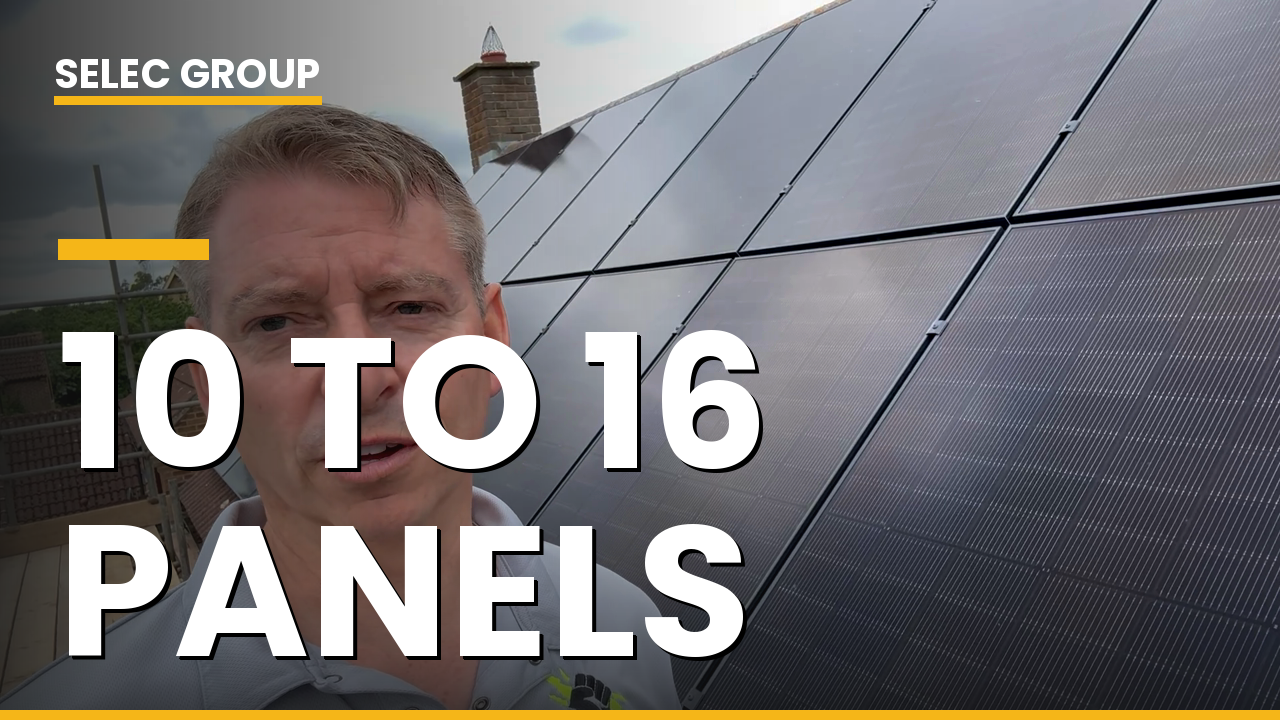
Here is a job that turned out to be a good example of a question I am often asked: how many panels should go on the roof. We originally quoted this house for ten panels. By the time the scaffold came down it had sixteen, and oddly enough the bigger system has a shorter payback than the smaller one would have. In this post I will explain how that happened, why measuring once the scaffold is up matters, and how adding panels can actually bring your payback period down rather than push it out.
We quoted ten, in landscape
When we first priced this roof, we planned for ten panels laid out in landscape, which means the panels sitting on their sides, the wide way round.
That figure was based on measurements taken from the ground. From down there you can get close, but you cannot be exact. This roof was a tricky one to assess from below, so we worked to a careful, slightly cautious estimate. Ten panels, landscape, was a sensible plan on paper.
What changed once the scaffold went up
Everything got easier once the scaffolding was in place. With the scaffold up we could get onto the roof and take the measurements exactly, which simply is not possible from the ground.
When we did, we found a little more usable space than we had expected. Not a huge amount, but enough to be worth a second look. So we ran the calculations again with the real measurements in front of us.
Portrait instead of landscape
The breakthrough was the panel orientation. Instead of laying the panels landscape, we worked out we could turn them portrait, standing them upright the tall way round.
This roof was particularly short, top to bottom, which is exactly why we had not expected portrait to work. But the accurate measurements showed it would fit. Turning the panels portrait let us tuck more of them onto the same area.
The result was that we could get sixteen panels on this roof instead of ten. That is a considerable increase in the amount of power the roof produces, all from the same structure.
More panels, shorter payback
Here is the part that surprises people. Adding those six extra panels cost a fair bit more money. The customer paid more for the bigger system. And yet the payback period of the whole system came down by six months.
So he spent more, fitted more, and the time for the system to pay for itself got shorter, not longer. That seems back to front until you look at the fixed costs.
The fixed cost effect, explained
The reason comes down to how a solar job is costed. Some costs are fixed and some are variable.
- Fixed costs stay the same no matter the system size. On this job that was the scaffolding, and notably the inverter and the battery, which were the same on the bigger system as on the smaller one. We did not need to upgrade them.
- Variable costs rise with size. The extra six panels themselves, and a bit more labour to fit them.
Because the big ticket fixed items were already paid for, the six extra panels only added their own modest cost. But they brought a full panel’s worth of generation each. So we spread the same fixed costs across far more electricity production.
More generation against costs that barely moved means each pound spent works harder. That is why the payback for the larger system is shorter. The extra panels are some of the best value kit on the whole job, because they ride on the scaffolding, inverter and battery you have already paid for.
The customer’s choice, not a hard sell
I want to be clear about how this went, because it matters to how we work.
This was the customer’s decision, not something we pushed. He did not have to go to sixteen. He could have stuck with the ten panels he was quoted, and we would have been perfectly happy to fit them.
We simply gave him the option. We showed him the numbers, explained that the extra panels would cost more but shorten the payback, and let him decide. He chose to go for it, and we got an accelerated delivery of the extra panels to keep the job moving. He now has a sixteen panel system.
That is the approach across all our work. We give you the facts and the options. We do not sell you something you did not ask for.
Why this does not happen on every job
This is not something we come across often, and I should explain why. We measure roofs carefully, so usually the plan we quote is the plan we fit. There are rarely surprises.
This roof was the exception. It was short enough that we did not expect portrait to be possible, and only the exact measurements taken from the scaffold revealed that it was. When the chance to add real value showed up, we took it to the customer rather than just fitting the original ten and saying nothing.
The bottom line
We quoted this roof for ten panels in landscape and fitted sixteen in portrait, once accurate measurements from the scaffold showed the space was there. The bigger system cost more, but its payback came down by six months, because the scaffolding, inverter and battery were already paid for and the extra panels simply added generation. It was the customer’s choice, and it worked out well for everyone.
If you want solar fitted by a team that measures properly and gives you honest options, we cover Cambridgeshire, Bedfordshire and Northamptonshire. Call the office on 01480 400607 or request a survey through our website.
Jason Pope
Owner, Selec Group